
Fields in DeKalb Property Tax Records
Each DeKalb property tax record answers a different question. The appraisal profile holds the valuation and exemption side. The Tax Commissioner holds billing and payment. Check the tax year and parcel key before comparing any figures.
| Field | What It Shows | Where |
|---|---|---|
| Appraised value | County estimate of full fair-market value | Board of Assessors |
| Assessed value | Forty percent of appraised value | Board of Assessors |
| Exemptions | Relief or special tax treatment on the profile | Board of Assessors |
| Tax bill and status | Charge, payment, balance, or delinquency | Tax Commissioner |
| Tax district | Geographic billing context | Appraisal and tax records |
DeKalb appraises real estate at full fair-market value and assesses it at 40%. A bill then folds in exemptions and the levy. It is not a sale-price statement.
DeKalb Assesses Forty Percent
The Property Appraisal resources confirm the standard. DeKalb County appraises at 100% of fair-market value and assesses at 40%. The sample profile shows the math plainly. An appraised value of $301,900 becomes an assessed value of $120,760. That ratio is not a price prediction. A parcel will not necessarily sell for its assessed value. The tax is not set by the ratio alone, either. Exemptions and the levy must land on top before anyone knows the bill.
January 1 Anchors DeKalb Tax
January 1 anchors the DeKalb County tax year. It is the assessment date. Property returns and many exemption applications run from January 1 through April 1. Annual assessment notices generally arrive after that window. The profile lists Current Ownership and Ownership on January 1st separately. A deed recorded later in the year can be newer than the roll itself. A notice states value and opens appeal rights. The bill comes later from the Tax Commissioner and covers the amount due. Save the notice date, tax year, and bill year with every record.
Read a DeKalb Appeal Record
The official sample appeal and value profile packs in a lot. Fields include PARID, tax district, owner and mailing address, notice values and dates, expiration and filing dates, hearing type, appeal reason, status, and appraiser contact. Appraised and assessed values appear too.
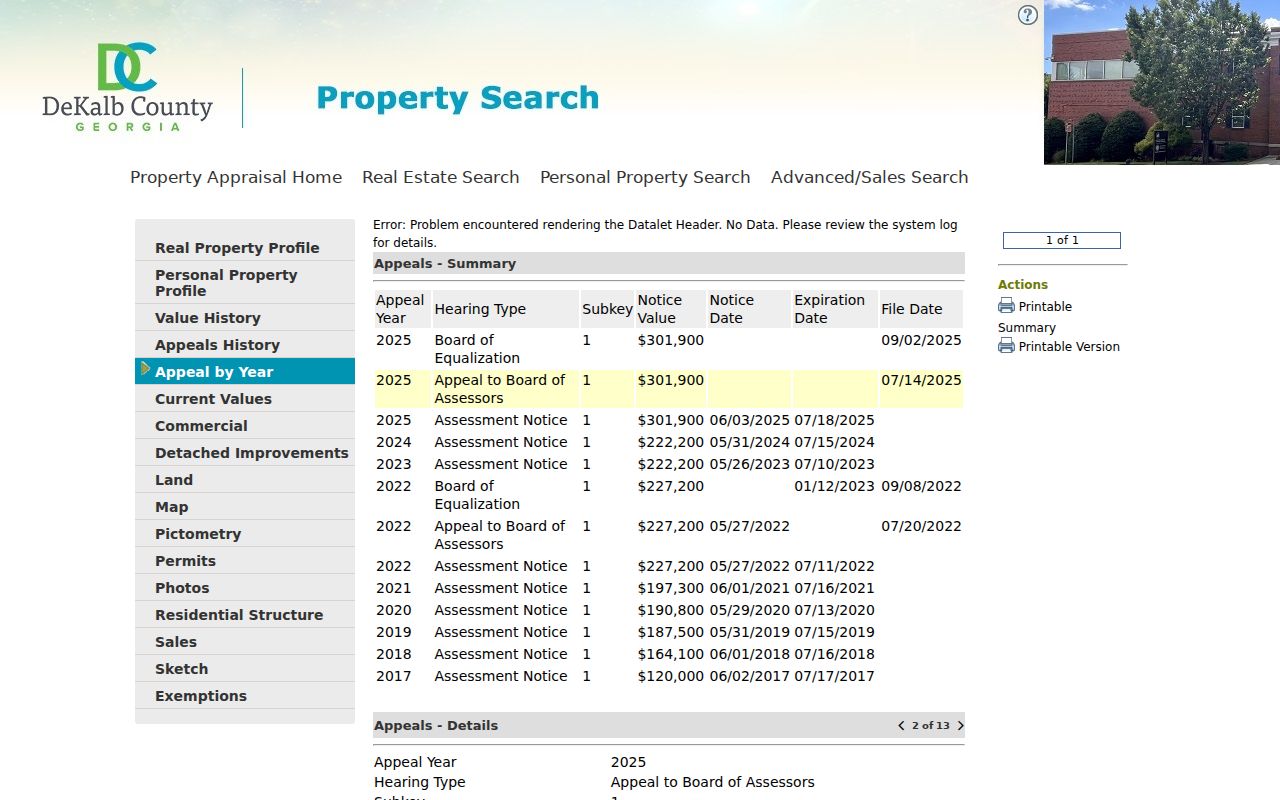
An appeal record can explain a changed value better than a current bill alone. The value history, hearing outcome, and filing dates all sit on one page.
Look Up a DeKalb Tax Bill
The Tax Commissioner property search returns results by Parcel, Owner, and Situs Address columns. The live form occasionally goes down for maintenance. Rely only on the fields the portal shows when you visit.
- Search the Tax Commissioner record by the available parcel, owner, or situs option.
- Match the parcel and tax year before reading a balance or payment.
- Compare exemptions and assessed value with the appraisal profile.
- Check prior years and delinquency through the tax portal or office.
- Confirm any tax-sale listing on the current official list.
- Assessed value
- The statutory portion of appraised value used in the tax calculation.
- Millage or levy
- The rate applied to the taxable base.
- Homestead exemption
- Relief for a qualifying owner-occupied home.
- Tax lien
- A claim tied to unpaid tax.
The official bill lookup is pictured below.
The portal is a dynamic system, so live fields and tax-year results can shift.
DeKalb Tax Exemptions and Relief
The county exemption page lays out the main programs. Qualifying organizations, conservation use, historic property, and Freeport treatment are among them. Each carries its own filing deadlines and covenant rules. Homestead and EHOST relief work inside the county tax system. They never change the deed owner. Check the exact exemption on the parcel and the year it covers. Qualification can turn on ownership, use, age, income, or a multi-year covenant. A nearby parcel proves nothing about another owner's eligibility.
DeKalb Delinquency and Tax Sales
The Tax Commissioner runs delinquent collections and publishes a tax-sale route. The online delinquency list can change from day to day, so pull the current list rather than working from an old date. Confirm parcel, owner, amount, and sale status with the office before acting. Property-tax questions can go to 404-298-4000 or proptax@dekalbcountyga.gov. Delinquent matters use delinquentcollections2@dekalbcountyga.gov. Mail for the Property Tax Division goes to P.O. Box 117545, Decatur, GA 30368-7545; Delinquent Collections uses P.O. Box 100001, Decatur, GA 30031-7001. Note: A listed delinquency may change through payment, correction, court action, or sale cancellation.
DeKalb Tax Digest in Context
The 2025 county digest notice shows how far DeKalb has climbed. Real and personal gross value rose from $35.64 billion in 2020 to $57.52 billion in 2025. The net digest after exemptions is $46.21 billion. The county also announced a tentative 12.427 mill rate against a 9.737 rollback rate. It includes continued residential relief. These are county-wide numbers. They forecast nothing for one property. A city's levy and a parcel's exemption status matter too. Its own appraised value can send a single bill down a very different path.
Separate DeKalb Notice and Bill
An annual assessment notice reports the Board of Assessors' value decision and the deadline to contest it. The Tax Commissioner's bill applies the tax structure afterward. The two share a parcel and tax year. They are not the same record. A notice may show appraised and assessed values without stating the final amount due. A bill may reflect exemptions, millage, prior balance, or payment status while saying nothing about how each appraisal component was chosen. DeKalb's 2026 annual notice example carries a May 29, 2026 notice date, a July 13, 2026 date line, the code KR for revaluation value, APN, address, and value fields. It also states that documents used to determine the 2026 value are available on request within ten business days. Keep that evidence request separate from the 45-day assessment appeal. One asks for existing valuation support. The other contests the value through the statutory route. When comparing years, save each notice, the profile's value history, exemption status, and the matching bill. A bill can jump for many reasons. Value, exemption, rate, district, or delinquency changes all leave their mark. Wait until the corresponding record shows the cause.
Build a DeKalb Appeal Record
A strong appeal packet starts with the county's own parcel facts. Check land size, use, building area, and the sketch. Improvement details, sales history, photos, and exemptions matter too. Flag each claimed error and cite a dated source. Comparable sales must match the relevant valuation date and be similar enough that the comparison explains itself. A repair estimate or photograph can support a condition claim, but neither changes the county record without review.
The inspected appeal profile shows how DeKalb stores the administrative trail. Its summary can list appeal year, hearing type, subkey, notice value, notice date, expiration date, and file date. Detail fields run deeper. They can include appeal reason, status, Board of Equalization flag, division, appraiser contact, result reason, and action dates. File the form and keep proof of timely delivery.
DeKalb lists several routes. Board of Equalization, arbitration, and Superior Court each apply. The choice changes procedure and potential fees, so read the current form and notice and use the route actually elected for the parcel.
Access DeKalb Tax Records Offline
Portal maintenance changes the route, not the search. The Tax Commissioner answers property-tax questions at 404-298-4000 and by email at proptax@dekalbcountyga.gov. Delinquent matters go to delinquentcollections2@dekalbcountyga.gov. A mailed request should name the APN, situs address, owner name, tax year, and the exact record sought, whether a bill, payment history, delinquency statement, or current tax-sale list.
Property Tax Division mail goes to P.O. Box 117545, Decatur, GA 30368-7545. Delinquent Collections uses P.O. Box 100001, Decatur, GA 30031-7001. Send appraisal evidence requests to Property Appraisal, not the collector. For a deed or recorded tax-sale conveyance, use the Clerk.
A written Georgia Open Records Act request can seek an existing nonexempt file that a portal does not display. The agency must usually respond within three business days. It must otherwise explain what exists, the estimated cost, timing, and any exemption. The law never requires a custom tax history. Ask for named bills, fields, lists, notices, or files in a preferred electronic format.
Appeal a DeKalb Assessment
An owner normally has 45 days from the annual assessment notice to file an appeal. The real-property appeal form comes through Property Appraisal resources. The route then shapes the review. Depending on the election, the case may proceed through the Board of Assessors, Board of Equalization, arbitration, or Superior Court.
Keep the notice, parcel ID, proposed value, sales evidence, property facts, photos, and any land or improvement data errors. The county's quick reference lists a $217 arbitration filing fee and a $25 Superior Court appeal fee. DeKalb published a specific extension notice for 2025. Each year's official deadline must be checked, never assumed.
Watch the notice date. The DeKalb assessment appeal period is normally 45 days. Use the deadline printed for that parcel and tax year.
Use the DeKalb Digest Carefully
The tax digest is an aggregate base. It combines many parcels and property classes, then accounts for exemptions to reach a net figure. A rise can reflect new construction, reassessment, ownership change, or other roll activity. The digest cannot say which cause hit one home. For parcel proof, return to the property's annual notice, value history, improvement record, exemption flags, and bill.
Millage comparisons need the right label. Tentative, rollback, and final adopted rates answer different questions. DeKalb's 2025 announcements documented hearings and residential relief. The matching final bill and tax year are still necessary before stating what a parcel owed. City millage can add a layer inside a municipality, while county appraisal supplies the base values.
Use the digest for context. Use the parcel profile for the individual record. That split keeps county-wide tax-base change from being mistaken for one property's market gain, and it explains why similar appraised values can yield different taxable results when exemptions, districts, or city levies differ.