
DeKalb Former Owners in Reverse
Work backward from grantee to grantor. Each step moves one owner earlier. The newest confirmed transfer comes first, and every older deed names the buyer who later became the seller. Record both parties, the instrument type, the recording date, and the book and page, because those details keep the chain repeatable when two people share a name or a firm changed its style.
| Transfer date | Grantor to grantee | Deed type | Book/page |
|---|---|---|---|
| Newest recorded transfer | Prior owner to present grantee | As indexed | Copy from latest index row |
| Earlier acquisition | Earlier grantor to prior owner | As indexed | Carry back from prior deed |
| Older book entry | Historic grantor to historic grantee | Read from deed book | Verify in Clerk holdings |
The GSCCCA Real Estate name search filters by party, instrument, county, name, and date. Results may list party names and property location. They may also show the instrument reference, book and page. Label choices can shift on a live portal. Copy them exactly as the current display shows them. The official form is the GSCCCA grantor and grantee search.
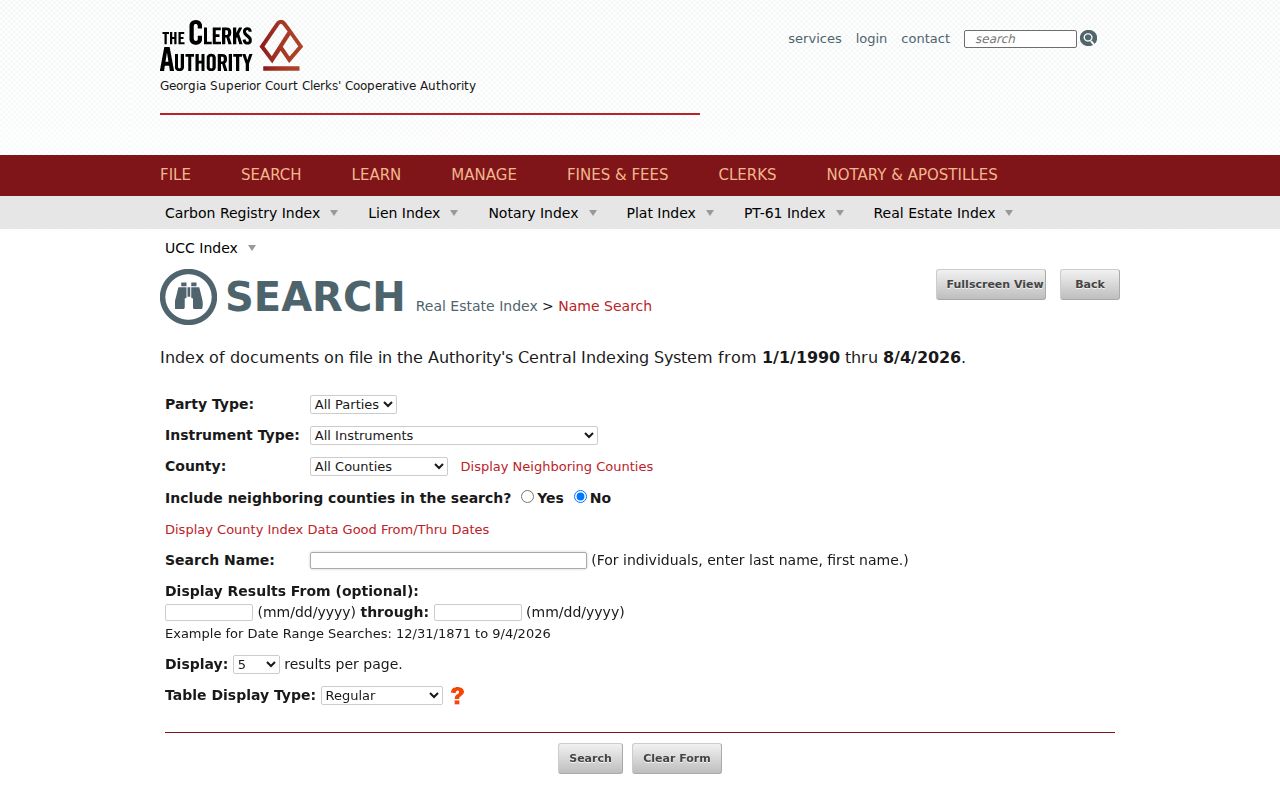
Party, instrument, county, name, and date filters, plus neighboring-county and display options, let a former-owner search run as a set of narrow, documented passes. Keep notes for each pass.
Rebuild DeKalb Ownership Backward
The same person swaps roles at every link. On the sale deed, a prior owner serves as grantor. On the older deed, that same person appears as grantee, having just acquired the parcel. Book and page, the parcel ID, and the legal description hold the chain in place. Each one ties it back to the land.
- Find the latest grantee deed through the Clerk or GSCCCA. Record all name forms, the recording date, instrument type, and book and page.
- Read the grantor on that deed. Search that grantor as a grantee, using a date range before the sale.
- Compare the legal description, subdivision, lot, land lot, and parcel ID. Reject same-name records tied to other land.
- Repeat until the online trail ends. Continue through the Clerk's deed books and older index tools.
- Grantor
- The person or entity conveying an interest.
- Grantee
- The person or entity receiving that interest.
- Chain of title
- The ordered run of instruments tied to the same land.
- Reverse index
- An index used to find an acquiring party as grantee.
- Warranty and quitclaim
- Different deed forms whose full text defines the interest conveyed.
DeKalb Deed Dates Need Labels
Three dates describe three different events. Execution, recording, and index coverage each answer a separate question. The Clerk reports surviving DeKalb County land records from 1842. The GSCCCA standardized deed index covers all Georgia counties from at least January 1, 1999, and the live name form opens with an index line dated January 1, 1990.
Coverage is not one date. Confirm the current county coverage table before claiming every DeKalb deed is online to 1990.
Label the source at every step. A physical book, a scanned image, a dynamic index, and an archive response each carry different limits. A gap online may reflect the format rather than a missing deed. The DeKalb Clerk Real Estate Division is the custodian.
DeKalb Owners Before the Fire
DeKalb County dates to 1822. Its 1829 courthouse burned in 1842. That fire sets the Clerk's stated surviving land-record line. A later courthouse built of Lithonia granite burned in 1916. The 1918 building now belongs to the DeKalb History Center story. The present courthouse opened in 1967.
Research before 1842 becomes reconstruction. Later deed recitals may name prior owners or describe an earlier conveyance. Probate files and tax material can supply more links. So can plats, newspapers, and state or federal land records. No single clue forms a complete title chain, though.
Book and Page Anchor DeKalb Owners
A name alone is a weak key. Spelling variants matter; the legacy Landmark notice says so plainly. Trusts, estates, spouses, and business names multiply the forms a name can take. Book and page cut through the confusion. They give the next clerk a direct document reference.
Copy requests by mail need the book type and page. The Clerk lists regular copies at $1 per page. Certified copies run $2.50 for the first page plus $0.50 for each added page. Plat copies cost $2 per page. Full details sit with the DeKalb deed records process. For a former-owner chain, the real task is keeping that reference at every step.
Note: A deed's recording date can differ from its execution or closing date. Record both when the image provides them.
Parcel Changes Hide Prior Owners
A current APN can hide more than one kind of change. That includes an old parcel split, a lot combination, a road project, or a tax-map change. COMPASS includes a parcel genealogy link for exactly that problem. Search predecessor and successor parcel numbers. Then match them against assessor history, plats, and deed legal descriptions.
DeKalb APNs come in more than one style. COMPASS uses a compact no-dash format. Assessor profiles show spaced PARIDs. Preserve what each source displays, and never infer a digit-by-digit formula the county has not published.
DeKalb Plats Outlast Street Names
Old addresses mislead. A former owner may have used a house number or street name that later changed. A subdivision, phase, lot, block, land lot, district, or deed call stays useful long after an address shifts. The GSCCCA plat index filters by county, name, instrument type, section or GMD, district, land lot, and date.
DeKalb Library city directories begin locally in 1928. Emory's Atlanta digital run starts with 1859/60. Together, directories and newspapers show occupants and street context, but they never prove an occupant owned the parcel. Tie each story to a deed or tax roll.
Estate Transfers Bend DeKalb Chains
Estate transfers rarely follow a clean sale pattern in DeKalb County. A decedent can stay on the tax roll while probate is still open. Personal representatives, trustees, life tenants, and remainder holders may also show up in the deed body. The form may not match the assessor name.
Search the estate and the person. Probate orders explain who had authority to sell. Yet the recorded deed is still what proves the transfer. When the name trail stalls, line up the dates and parties in the probate file. Then check the next instrument in the real-estate index.
Offline Routes to DeKalb History
A portal outage is not a dead end. The DeKalb County Clerk keeps a public-access room, phone help at 404-687-3812, mail copy requests, and eCertification. Visit the Ground Floor at 556 N. McDonough Street in Decatur on weekdays from 8:30 a.m. to 5 p.m. Older property records may need the DeKalb Library's directories, newspapers, census holdings, and maps, plus the Georgia Archives, Virtual Vault, FamilySearch, or the Clerk's own archives. A written Georgia Open Records Act request can reach a record that is not posted online. The office does not have to build a custom former-owner report for you, though it must provide existing records it holds.
Limits on DeKalb Owner History
A backward chain in DeKalb County can miss a deed. Spelling drift, wrong dates, entity names, and thin index coverage all hide instruments. Gaps from a fire, an estate, a parcel split, or conflicting legal descriptions call for a lawyer's title work rather than guesswork.
Use records with care. Former-owner research supports lawful house history and purchase review, not harassment, and it is not a title opinion.
The recorded deed wins. An old tax roll entry carries less transfer weight than the last deed in the deed records. Still, even a thorough deed search cannot rule out every lien, probate issue, court order, or unrecorded claim, so leave decisions that turn on legal ownership to a title professional.