
Run a DeKalb Property Search
Begin with the fact least likely to be wrong. An address is easy to type. But the parcel number is the strongest key across DeKalb County systems. The free COMPASS Property Search accepts a parcel, an owner, or street details. It links each result to deeper property information. Change one term at a time if a query comes back empty.
- Enter the house number and street name in COMPASS. Reduce the criteria if no match appears.
- Open the parcel and save its APN. Confirm that its situs address is the intended land.
- Read Current Ownership, January 1 ownership, mailing address, value, sales, and legal clues in Property Appraisal.
- Carry the owner, subdivision, or book and page into the GSCCCA deed index.
- Use the APN in tax and GIS records, then order a Clerk copy when the instrument matters.
That sequence keeps one DeKalb County property search anchored to one lot. A recorded deed can be newer than the annual tax snapshot. A split or combined lot may carry a brand new APN, so recheck the key before trusting older results.
DeKalb Property Search Fields
COMPASS offers a compact field set. The form marks no input as required, so loosen one field at a time whenever a strict DeKalb parcel query fails.
| Field | Input | DeKalb search note |
|---|---|---|
| Parcel Number | Text | Enter without dashes, such as 0101100001. |
| First Name | Text | Pair with Last Name, then remove if too strict. |
| Last Name | Text | Useful alone for a wider owner search. |
| House Number | Text | Use with Street Name for situs search. |
| Street Name | Text | Try fewer terms when there is no result. |
| Parcel genealogy | Link | Tracks historical changes to a parcel. |
The assessor menu adds real estate, owner, address, parcel, advanced sales, and map modes. Its dynamic form undergoes periodic maintenance, so open the live screen before assuming any field is mandatory. The official COMPASS search form is the county's public entry point.
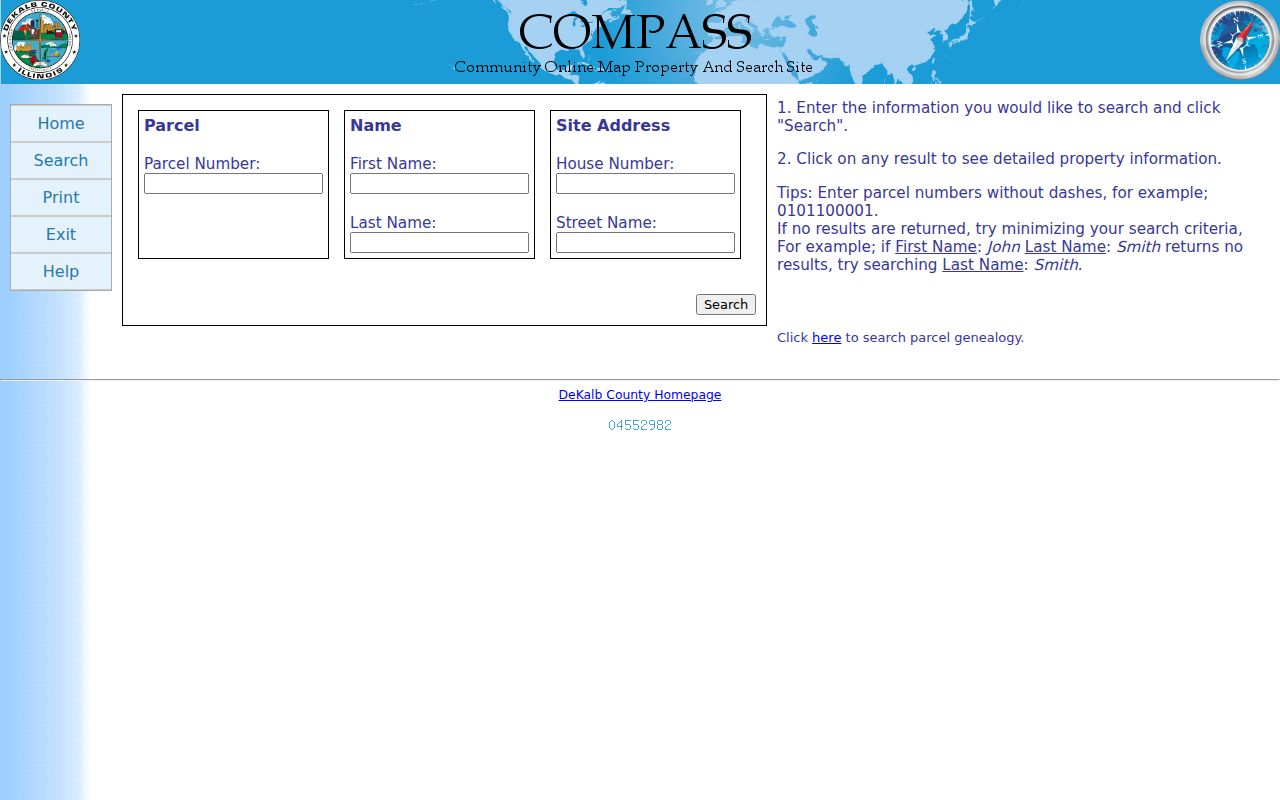
The form presents simple APN, name, and street inputs for the opening property search step.
DeKalb APNs Use Two Forms
COMPASS wants an APN without dashes. An assessor profile may display a spaced PARID such as 18 297 09 013. The county publishes no digit-by-digit decoder. Copy each version straight from the official result instead of guessing at a reformat. Parcel genealogy matters most when land was split, joined, or replatted. Record the present key and the earlier one. Then compare deed and plat references side by side. A modern map polygon does not always match an older tract boundary. Note: Save both the compact COMPASS key and the spaced assessor key with your DeKalb County property search notes.
Read a DeKalb Property Result
The DeKalb Property Appraisal profile is a tax record full of leads. It separates Current Ownership from Ownership on January 1st. Its tabs cover values, appeals, land, buildings, maps, permits, photos, sales, sketches, and exemptions.
| Current Ownership | Owner and co-owner names carried in the profile. |
|---|---|
| January 1 ownership | The name tied to Georgia's annual assessment date. |
| PARID and tax district | Parcel key and taxing geography. |
| Mailing and situs | Correspondence destination versus land location. |
| Values and notices | Appraised, assessed, notice, and appeal fields. |
| Property tabs | Land, structures, sketch, permits, sales, exemptions, and map. |
The official real-property search remains the DeKalb entry point even when maintenance limits its dynamic form.
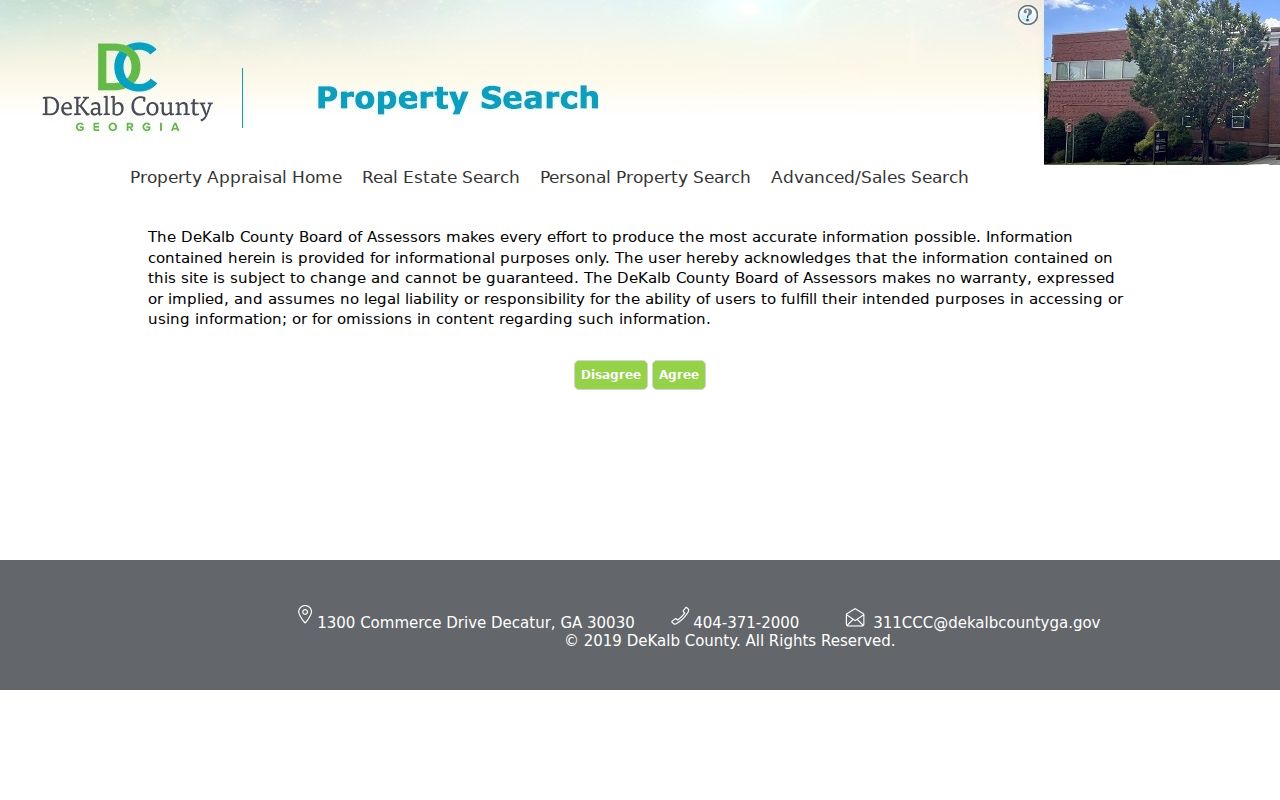
The page connects an owner, address, or parcel query to the appraisal profile and its tax-year tabs.
DeKalb Situs and Mailing Records
Situs means where the property physically sits. The mailing address is where tax bills go. The two can differ for an entity, a tax service, or an out-of-county owner. One DeKalb appeal record showed an LLC with a mailing address outside the city, which proves the mailing city is not the parcel's jurisdiction. The legal description plays a third role. It names a subdivision, lot, block, district, land lot, or metes-and-bounds tract even when a street number changes. ZIP codes are mail routes and can cross city lines. Confirm the address through GIS before assigning municipal permit jurisdiction.
Search DeKalb Entity Owners
An owner search can return an LLC, a trust, an estate, a trustee, or a shortened name. Search the assessor wording first. Then test punctuation and spelling variants in the deed index. DeKalb's Landmark disclaimer specifically warns users to try every spelling variation. Georgia's Secretary of State business record can clarify an entity's legal name or registered agent. It cannot prove parcel ownership, and the agent is not the owner of record. Estates can stay on the assessment roll while a probate transfer is still pending.
Move DeKalb Results to Deeds
Turn to the GSCCCA Real Estate name search once the assessor supplies an owner. Its form filters by party type and instrument type. County, neighboring counties, name, date range, result count, and table display are also options. Results give parties, location, deed book and page, a document reference, and images where access permits. Compare grantor and grantee spelling and document type. Check recording date, legal description, lot, land lot, plat, and book and page too. A PT-61 consideration figure is separate from any assessor value. The DeKalb County deed records workflow covers the recorded chain in depth. GSCCCA states its statewide index covers all counties from at least January 1, 1999. It continues adding older data. A live form once displayed a 1990 date line. But that alone does not prove complete DeKalb image coverage back to 1990.
DeKalb Search Access Channels
COMPASS and the appraisal profiles are free public starting points. GSCCCA summaries and images can require an account or payment. Its account page lists $5 single-use access for a four-hour index session. Limited-use access may omit document images. The Clerk accepts copy requests at the counter and by mail. Mail requests need book type and page. They also need a cashier's check, money order, or attorney's check. When a portal is down, use the office phone, email, counter, or a written Georgia Open Records Act request. The agency normally must produce the record within three business days. Otherwise it must explain the timing, cost, or an exemption.
DeKalb Parcel Genealogy Adds Context
Old tracts rarely sit still. A parcel gets split, combined, or replatted, and its old deed no longer matches today's map. Parcel genealogy closes that gap. Start with the current parcel number, note any prior or successor key, and match each one to its legal description and plat reference. Historic street numbers and directories add helpful context. Deeds and plats still prove the continuity.
This is why an exact old APN can return nothing today, and why you should not leap from one modern polygon to a nearby historic tract that once carried the same name.
Inspect DeKalb Parcel Profile Tabs
A matching address only opens the door to a DeKalb County property search. The appraisal profile organizes its evidence into tabs. Current Values and Value History carry the tax-year context. Land, Residential Structure, Detached Improvements, and Commercial break down the appraisal itself. Sales may show a date, a price, and a recording clue where populated. Sketch, Photos, Pictometry, Map, and Permits add visual or project detail. Exemptions and Appeals reveal administrative treatment. Annual Notices links year-specific documents. Note the active tax year before you move between tabs. A value from one year should never be paired silently with an owner or exemption from another.
The tabs also test a weak match. One house number may cover several parcels. A commercial address can span several tax lots. Compare PARID, tax district, situs, legal description, land traits, and map position before accepting a result, since a condominium may also need its unit. A blank sale or permit tab proves little. The profile simply displayed no data, and that does not rule out a conveyance or a city permit, so take the question to the Clerk or the city custodian. Copy the parcel key first, because dynamic detail cards may not retain the original query.
Repair a Failed DeKalb Search
A zero-result screen is a prompt, not a verdict. For an owner query, drop the first name and try the surname alone before testing initials and punctuation. For an entity, search the assessor's exact style, then versions without commas, periods, or suffix spacing. Trusts may sit under the trust or the trustee. Estates may use the decedent, executor, or estate name, and Landmark warns specifically about spelling variants, so keep a list of every form you tried.
Addresses fail for their own reasons. Strip the city and ZIP first. Then check the street suffix and compare it with the standardized situs. Old deeds may point to a former street name. ZIP is delivery geography and cannot establish municipal jurisdiction. When the address still fails, switch to subdivision, lot, block, district, land lot, or book and page.
For parcels, keep both formats. That means the compact COMPASS string and the spaced assessor form, plus a genealogy check for any split, combination, or replat. Broadening name, date, instrument, and geography at once hides why a row matched, so change one term at a time.
Classify DeKalb Property Evidence
DeKalb systems disagree for a simple reason. Each one captures a different event on a different date. The assessor card is a tax-roll snapshot. A deed or release is a recorded instrument. A plat is a filed survey exhibit. A GIS polygon is only a spatial reference, a permit is an administrative project record, and a court docket is procedural history. Classify each result before comparing, so a map label is never mistaken for a deed or an assessment for a sale appraisal.
Keep every handoff visible. Address leads to APN, APN to the assessor, owner to the deed index, prior grantor to the earlier deed, and legal description to the plat. Tax status belongs to the Tax Commissioner, while a boundary question moves from GIS to the recorded plat and, when the line matters, to a licensed surveyor. Search results organize evidence, but they can never become a certified title report.
Use each source's date. Save the tax year, recording date, notice date, and inspection date separately so older and newer facts do not appear simultaneous.
Choose a DeKalb Search Key
Each search key does a different job. Address is the easiest way in. Owner name can surface several holdings but invites false matches, and APN is the strongest handoff once the right lot is known.
| Key | Best use | Official routes | Main caution |
|---|---|---|---|
| Address | One known site | COMPASS, assessor, tax | Units, old names, city edges |
| Owner | Parcels or deed parties | Assessor, GSCCCA | Same names, entities, estates |
| APN | One lot across systems | GIS, appraisal, tax | Spacing and parcel genealogy |
- Parcel or APN
- The county tax-map identifier, not a legal description.
- Situs address
- The assigned physical location of the parcel.
- Owner of record
- The name carried by a source for its stated date.
- Parcel genealogy
- The link between current and earlier parcel identifiers.
A search is not title proof. County rolls, maps, and index entries are leads. Clear title requires review of recorded instruments and possible unrecorded interests.
Use DeKalb Legal Description Keys
Legal descriptions bridge change. DeKalb deeds and plats may rely on subdivision, lot and block, Sec/GMD, district, land lot, or metes and bounds, so copy those clues instead of guessing a parcel formula. When a tract was replatted, record old and new plat names, phases, lots, and book and page references. Streets change while land stays traceable. An APN can change too. The deed chain still points to its parent tract. County GIS can confirm a likely deed or plat book and page from an address or parcel ID. It cannot issue the copy, settle an encroachment, or replace a survey. Use the reference as a handoff to the Clerk.
Keep the final parcel match with the dated source records used to verify it.