
DeKalb Deed Records by Type
The DeKalb County Clerk of Superior Court handles deed records through its Real Estate Division. It records conveyances and every other instrument affecting title. A deed type describes the transfer form. It does not prove the chain is free of every claim. Read the body, legal description, signatures, and recording data before drawing conclusions.
| Deed type | What it does | Common use |
|---|---|---|
| Warranty deed | Conveys title with stated covenants | Arm's-length sale |
| Limited warranty deed | Limits the grantor's promises | Entity or commercial transfer |
| Quitclaim deed | Transfers whatever interest exists | Family transfer or title cleanup |
| Gift, estate, or trustee deed | Transfers through a named legal role | Estate or trust administration |
| Foreclosure or tax deed | Records a statutory transfer | Foreclosure or tax sale |
Not every filing conveys land. A security deed, lien, assignment, cancellation, easement, or UCC filing can affect it anyway. The Clerk indexes these records beside deeds, so one chain can reveal both transfers and encumbrances across the parcel.
DeKalb Clerk Holds Land Instruments
The Real Estate Division holds deeds, security deeds, liens, plats, and condominium plans. Foreclosure deeds, PT-61 forms, powers of attorney, and related filings are kept there too. Conveyances must carry the DeKalb tax parcel ID on the first page. Since January 1, 2025, HB 1292 requires self-filers to eRecord real-estate documents through an approved service. Under that law they must also upload government ID.
That rule governs filing only. It does not change when an owner name updates on the annual assessment roll. For a new sale, compare the recording date against the assessor's January 1 snapshot.
DeKalb Deed Index Search Fields
The GSCCCA name search offers every field a focused county query needs. If the first search fails, widen one setting at a time.
| Field | Use | Caution |
|---|---|---|
| Party Type | Grantor or grantee role | Role depends on the instrument |
| Instrument Type | Limit the filed record | Broad search can catch variants |
| County | Select DeKalb | Neighboring counties are optional |
| Search Name | Last name, first name | Test spelling and entity forms |
| Date Range | Bound the recording period | Uses month/day/year |
| Coverage display | Show index good-from dates | Verify DeKalb depth live |
Official results describe parties, property location, county, book and page, full index data, and an image where county participation and account rights permit. The statewide grantor-grantee form puts each of those choices in one place.
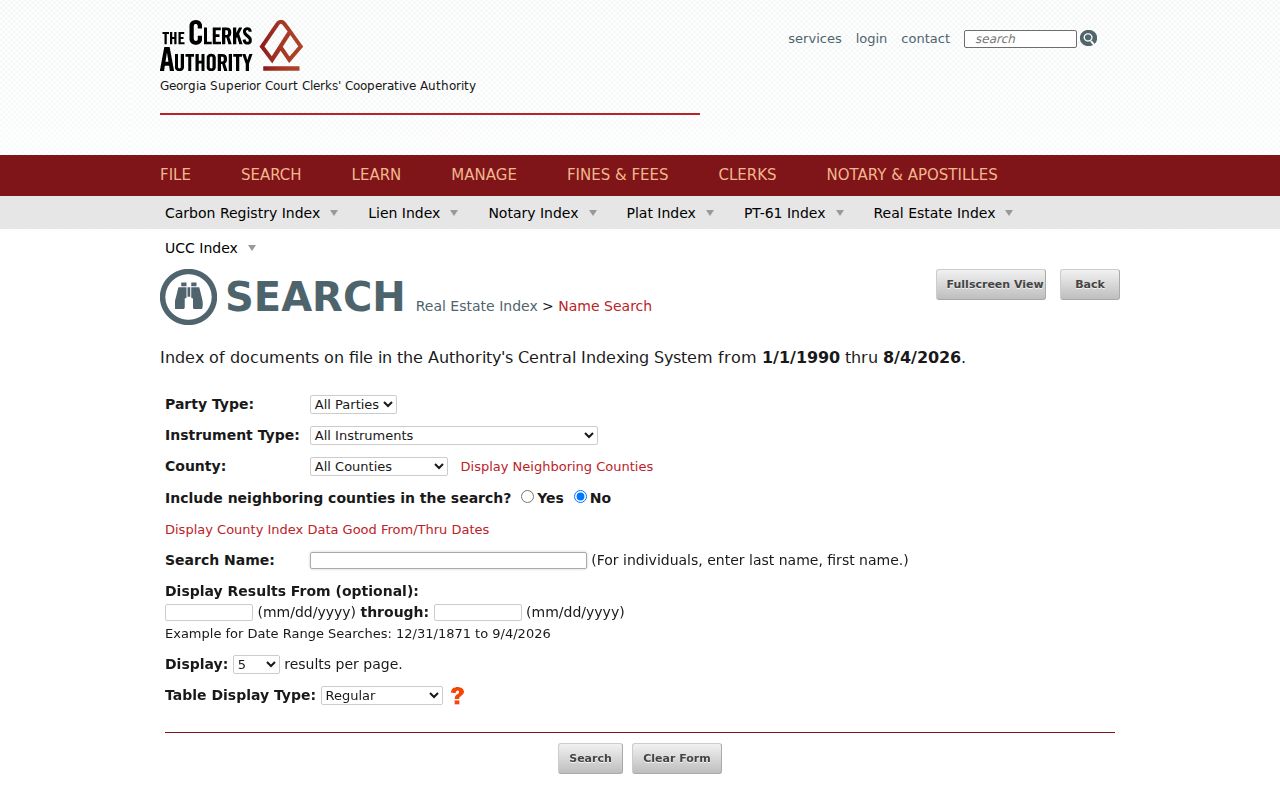
Party role, instrument type, county, date, and spelling all live on the form. Together they make a deed search reproducible.
Follow DeKalb Grantors and Grantees
A grantee receives an interest. A grantor transfers one. Start from the newest known owner on the assessor roll, then test the chain in the deed index. Names alone fall short where two people share a name or an entity changed its style over time.
- Search the present owner as grantee and identify the purchase deed.
- Read the grantor, recording date, book/page, and legal description.
- Search that grantor as an earlier grantee and repeat.
- Track liens, security deeds, releases, easements, and plat references.
- Move to Clerk books when online coverage ends.
- Grantor
- The party transferring an interest.
- Grantee
- The party receiving an interest.
- Chain of title
- The linked sequence of recorded transfers for the same land.
- Book/page
- The volume and page used to retrieve a filing.
- Instrument number
- A separate recorder reference assigned to a document.
DeKalb Deeds Survive From 1842
The Clerk reports surviving land records dating from 1842, because an earlier courthouse burned. GSCCCA separately states its statewide real-estate index covers all counties from at least January 1, 1999. It also lists added historic data. A live form once showed a broader 1990 interface line. That does not prove every DeKalb image runs complete to 1990.
Older work may call for deed books, later deed recitals, probate files, and plats. Tax sources and library material may help too. Another courthouse fire destroyed the 1898 Lithonia-granite building in 1916. Even so, the Clerk stands by its claim. Its current statement still places the start of surviving land records at 1842.
Note: Record whether each deed link came from a physical book, scan, index entry, or certified copy.
DeKalb Deed Records at Scale
The Real Estate Division reports more than 204,500 title-affecting documents each year. These include over 641,500 pages and about 800 virtual deed books. It also reports more than 26,500 mortgage cancellations and 82,000 cross-references annually. At that scale, exact names and references matter. The figures do not measure completeness for one parcel. A missed spelling, trust name, wrong date, or wrong party role can hide a filing. That makes precision essential.
DeKalb PT-61 Transfer Trail
A deed of conveyance requires a PT-61 transfer-tax filing unless an exemption applies. It can supply consideration or transfer-tax data distinct from the assessor's appraised value. Neither figure alone proves market price. Use PT-61 as a check on the transfer date and the parties. Then read the deed itself for the estate conveyed. Check the legal description, reservations, and plat references there too. Remember that a security deed secures debt rather than serving as the sale conveyance.
Watch DeKalb Filings With FANS
The free Filing Activity Notification System can send an alert. It does so when a filing matches a registered name or property. It is a fraud-warning tool. It is not a title search. It does not prove a filing is valid. The Clerk has warned that a registry upgrade generated erroneous notices. Verify any surprising alert with Real Estate at 404-687-3812 before acting on it.
Read DeKalb Deed Cross-References
No deed tells the whole story by itself. Its legal description may point to a plat, a condominium plan, or an easement. It may also point to a right-of-way or an earlier book and page. A security deed often links forward to an assignment, modification, cancellation, or release. Liens, too, can tie to a cancellation or a court disposition. Copy each reference down exactly before you chase the next index entry. The same book and page can appear twice. That repetition can show two filings describe the same land, even after a name or street address changed.
The Clerk logs more than 82,000 cross-references a year. That volume tells you how much recording work runs through them. Follow links in both directions. A cancellation without its security deed is bare. And an old deed without its cancellation can leave a satisfied debt looking open. For plat references, the GSCCCA plat search offers fields for instrument type, county, and name. It also offers fields for Sec/GMD, district, land lot, and date. GIS can suggest a likely book and page. Yet only the Clerk issues the actual deed or plat copy.
Execution and recording dates are not the same thing. Execution is the signing. Recording is the Clerk's acceptance into the public chain. The gap between them can be long, and a later recording date alone never proves a second transfer happened.
Resolve DeKalb Deed Name Variants
Landmark's own warning about spellings is worth taking seriously. One deed indexes a man with a middle initial. The next spells out the full middle name. Entities gain or drop punctuation, abbreviations, and corporate suffixes. Trust property may sit under the trustee, the trust, or both at once. Estate transfers can name an executor, an administrator, the decedent, or simply the estate. Start with the broadest reliable surname or entity stem. Then narrow the field using date, instrument type, co-party, legal description, and book/page.
A shared surname does not make a chain. Check subdivision, lot, block, land lot, district, metes-and-bounds text, parcel ID, and any prior reference. Do all of this before you connect filings. Since July 1, 2019, DeKalb conveyance filings must carry the parcel ID. That makes it a strong cross-check for recent deeds. Older instruments lean more on the legal description and the plat.
Suppose the assessor shows an LLC as owner of record. The Georgia Secretary of State's business record can confirm the entity's legal style. It can also confirm the filing identity. A registered agent is not presumed to hold the land. Only the recorded grantee and the deed body settle that question.
Continue DeKalb Deeds Offline
A missing image online does not mean the deed is gone. GSCCCA index summaries and images depend on account rights and digitized coverage. The DeKalb legacy portal has its own login conditions. Take the index reference to the Real Estate Division. Request a regular or certified copy. The office sits at 556 N. McDonough Street, Ground Floor, Decatur, open Monday through Friday, 8:30 a.m. to 5 p.m. Real Estate answers at 404-687-3812; the general land-record line is 404-371-2836.
Chains that predate online records need the deed books. Work through one transfer at a time. Recitals in later deeds often cite earlier book and page references. Probate files can explain why an estate conveyance happened. Plats hold subdivision and lot identity steady when street numbers changed. Tax rolls and directories add color, but neither substitutes for a genuine deed link. The pre-1842 gap from the courthouse fire may demand state and federal land sources, historic maps, and newspapers. Later instruments reciting earlier ownership can also help.
Beside each result, note how you reached it. Was it a physical book, a scanned image, the statewide index, the county portal, a mailed copy, or a certified copy? That single note keeps the evidence level honest when formats mix within one chain.
Order a DeKalb Deed Copy
Images may be reachable through GSCCCA or the legacy Landmark portal. Accounts and permissions apply. Landmark cautions that data changes and urges testing of spelling variations. Regular and certified copies are also available at the Clerk's counter. You can also order by mail or through eCertification.
A mail request must state the book type and page. Regular copies run $1 per page. Certified copies cost $2.50 for the first page plus $0.50 for each added page. Plat copies cost $2 per page. Mail payment takes a cashier's check, money order, or attorney's check. An eCertification request must be paid within six days.
Recorded does not mean clear. DeKalb deed records show filed instruments. They do not resolve every unrecorded interest or provide a title opinion.
The official DeKalb Landmark entry screen appears below.
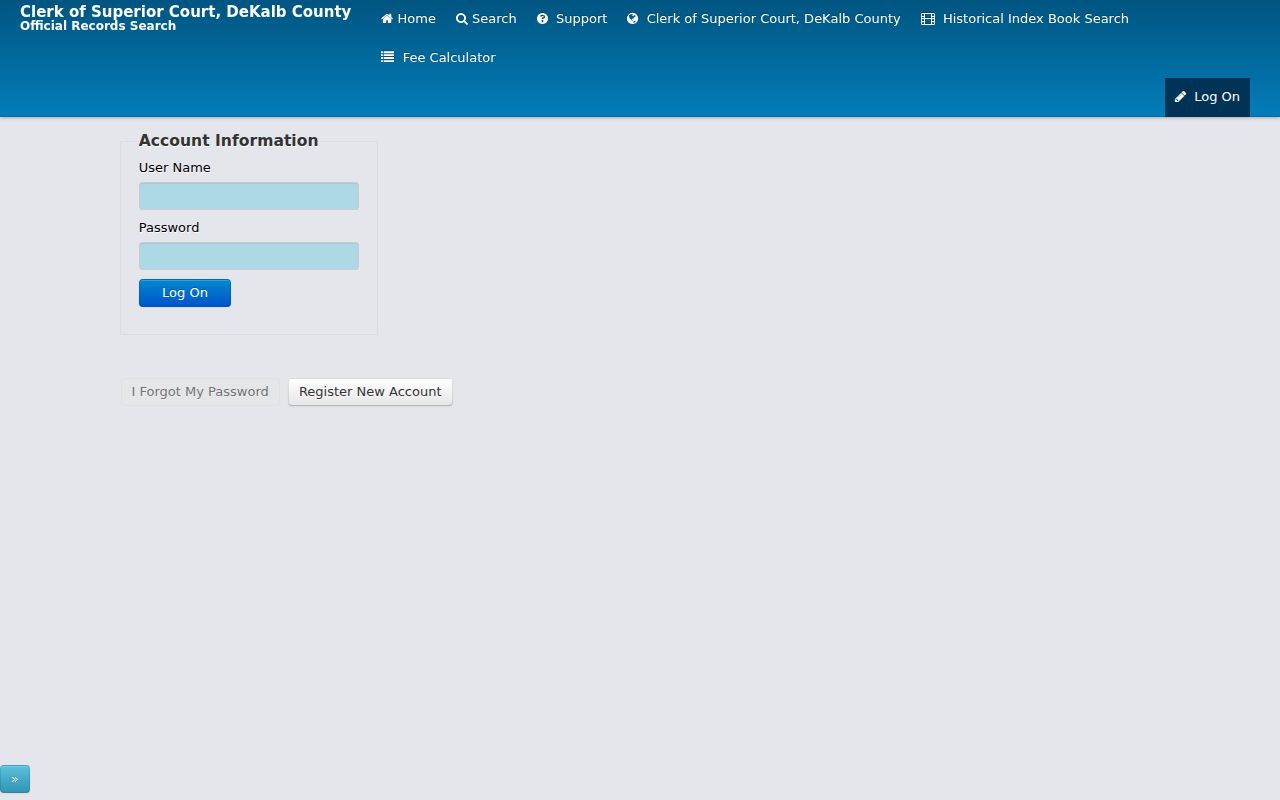
That login gate is exactly why the counter, mail, phone, and eCertification routes still matter for deed access.
Keep the returned book/page, copy type, payment, and request date with the document. That record lets anyone verify the official source years later.