
How to Search DeKalb County Property Records
A street address is the easiest way in. Type the house number and street name into DeKalb COMPASS or Property Appraisal, open the matching parcel, and copy its APN. COMPASS also accepts a name or a parcel number without dashes. Loosen the fields if a strict search comes back empty. One address can even sit across several parcels.
The APN is the handoff key. Check it against the assessor profile, the newest Clerk or GSCCCA deed, the Tax Commissioner's bill record, and the county parcel map. An index only points to a recorded instrument. A certified copy carries more weight for formal use. Neither an assessor entry nor a GIS line guarantees title or a surveyed boundary.
- Search the assessor or COMPASS by address and record the APN.
- Use owner and legal-description clues to locate the latest deed.
- Check the assessment, exemptions, bill, and payment history.
- View the parcel with nearby lots and map reference layers.
- Order a regular or certified copy when an index is not enough.
DeKalb County Property Records Offices
Four county functions split the record. The Clerk of Superior Court records deeds, plats, liens, security deeds, PT-61 forms, and related instruments. The Board of Assessors maintains ownership and valuation profiles. The Tax Commissioner issues bills, records payments, and handles delinquency channels. GIS keeps parcel references, addresses, and mapping tools. Pick the office that answers your question, then carry the APN, instrument number, or book and page to the next system.
Clerk of Superior Court, Real Estate
556 N. McDonough Street, Ground Floor
Decatur, GA 30030
404-687-3812
DeKalb Board of Assessors
Current ownership, January 1 owner, values, sales, and exemptions
DeKalb County, GA
DeKalb Tax Commissioner
Property Tax Division, P.O. Box 117545
Decatur, GA 30368-7545
404-298-4000
DeKalb Property Search Fields
COMPASS offers three practical routes into DeKalb County property records. The parcel route wants the APN without dashes. The owner route splits first and last name. The address route separates house number from street. When punctuation, initials, suffixes, or a mailing-address mismatch defeats a narrow search, a broad last name or street-only attempt can still recover the record. Open the result and keep the number exactly as the portal shows it, since COMPASS and assessor profile URLs format the same identifier differently.
| Starting clue | COMPASS fields | Next record |
|---|---|---|
| Street address | House Number, Street Name | Parcel profile and APN |
| Owner | First Name, Last Name | Matching parcel list |
| Parcel | Parcel Number, no dashes | Detailed property information |
An assessor profile can add current ownership, January 1 ownership, mailing and situs addresses, tax district, appraised and assessed values, sales, exemptions, land, improvements, sketches, photos, permits, appeals, and map links. Dynamic systems change. Save the tax year and date viewed with any copied value.
DeKalb Deeds Survive From 1842
DeKalb land records survive from 1842, the Clerk reports. A courthouse fire destroyed the earlier books. That date describes the county archive, not the full range of one online portal. GSCCCA states its statewide deed index covers every Georgia county from at least January 1, 1999. Historical material is still being added. Its live form showed a 1990 start, but that interface line is not proof that every DeKalb image and index entry runs complete back to 1990.
Older chains often need book-and-page work. Search spelling variants, initials, trusts, company names, subdivision names, lot and block, land lot, and prior parcel numbers. The Decatur Library's city directories from 1928, newspapers, Sanborn maps, and regional directory runs can link an old address or occupant to the parcel. Still, the deed remains the transfer record.
Read DeKalb Ownership Dates Carefully
The Property Appraisal profile separates Current Ownership from Ownership on January 1st. That second label matters. Georgia assessment records use an annual snapshot. A deed recorded after January 1 may document a transfer before the tax roll catches up, so an owner of record can lag the newest deed. DeKalb has published no average update lag, and no fixed delay should be assumed.
Fresh transfer check. Compare the newest recorded deed with the assessor profile instead of treating a tax-roll name as conclusive.
The county's owner-correction instructions reinforce the split. GIS accepts only one thing. A signed, notarized, recorded deed is required for an ownership update. Send that deed to the deed team with the address or parcel ID. A lease, private contract, or unrecorded claim cannot replace the instrument.
DeKalb Appraised and Assessed Values
The Board of Assessors appraises real estate at 100 percent of fair market value for tax purposes. It then assesses that value at 40 percent. A sample profile showed an appraised value of $301,900 against an assessed value of $120,760. That illustrates the math. Those figures differ from a recent sale price, a private appraisal, or the final tax due. Exemptions, taxing districts, and millage shape the bill after value is set.
Use the value-history and appeal tabs to record the tax year, notice value, notice date, expiration date, filing date, hearing type, and result. Then turn to the Tax Commissioner portal for the bill and payment side. Keep assessment and collection records apart. That prevents a common error: reading a market estimate as tax due, or treating a paid bill as proof the valuation was right.
Types of DeKalb County Property Records
Think of DeKalb County property records as a connected set, not a single file. Each record answers a different question. Deeds trace ownership transfers. Security deeds, liens, and releases show recorded claims against a parcel. Assessments state annual ownership and value data, and tax records track billing and payment activity. Plats and GIS tie the legal description to a mapped lot. City permit and zoning files document local development review. Match the record type to the question first.
| Record Type | What It Documents | Kept By | Access |
|---|---|---|---|
| Deeds | Ownership transfers, parties, legal description, book and page | Clerk / GSCCCA | Online index; copies from Clerk |
| Security deeds and liens | Financing, judgments, tax or mechanics claims, releases | Clerk / GSCCCA | Index, record room, copy request |
| Tax and assessment | Owner roll, value, exemptions, bills, and payments | Assessors / Tax Commissioner | Public portals and office channels |
| Plats and parcels | Lot, block, land lot, map context, and recorded plat reference | Clerk / GIS | Map viewer; plat copies from Clerk |
| Building and zoning | Permits, inspections, cases, plans, and approvals | Municipal or county agency | City portal or open-records request |
For the transfer chain, use DeKalb County deed records. Assessments and bills sit on the property tax records page. A recorded plat can clarify a lot description, but a licensed surveyor must settle any on-the-ground boundary or encroachment dispute.
GSCCCA Deed, Lien, and Plat Records
The Georgia Superior Court Clerks' Cooperative Authority gives DeKalb County property records a statewide search route. Its name search is flexible. You can query by grantor or grantee, date, county, instrument type, party type, book and page, or property terms like subdivision, unit, block, and lot. A grantor gives up an interest. A grantee receives one. Search both roles when rebuilding a chain, since the same party flips sides with each conveyance. Lien and plat indexes are separate tools. A clean deed index entry does not clear liens, and a GIS polygon is no substitute for a recorded plat. Index summaries usually open before an account or payment is required for an image. Copies carry set fees. A regular paper copy from the Clerk runs $1 per page. Certified deed copies cost $2.50 for the first page plus $0.50 for each added page, and plat copies cost $2 per page. Mail requests need the correct book type and page. The GSCCCA name-search screen shows the statewide entry path.
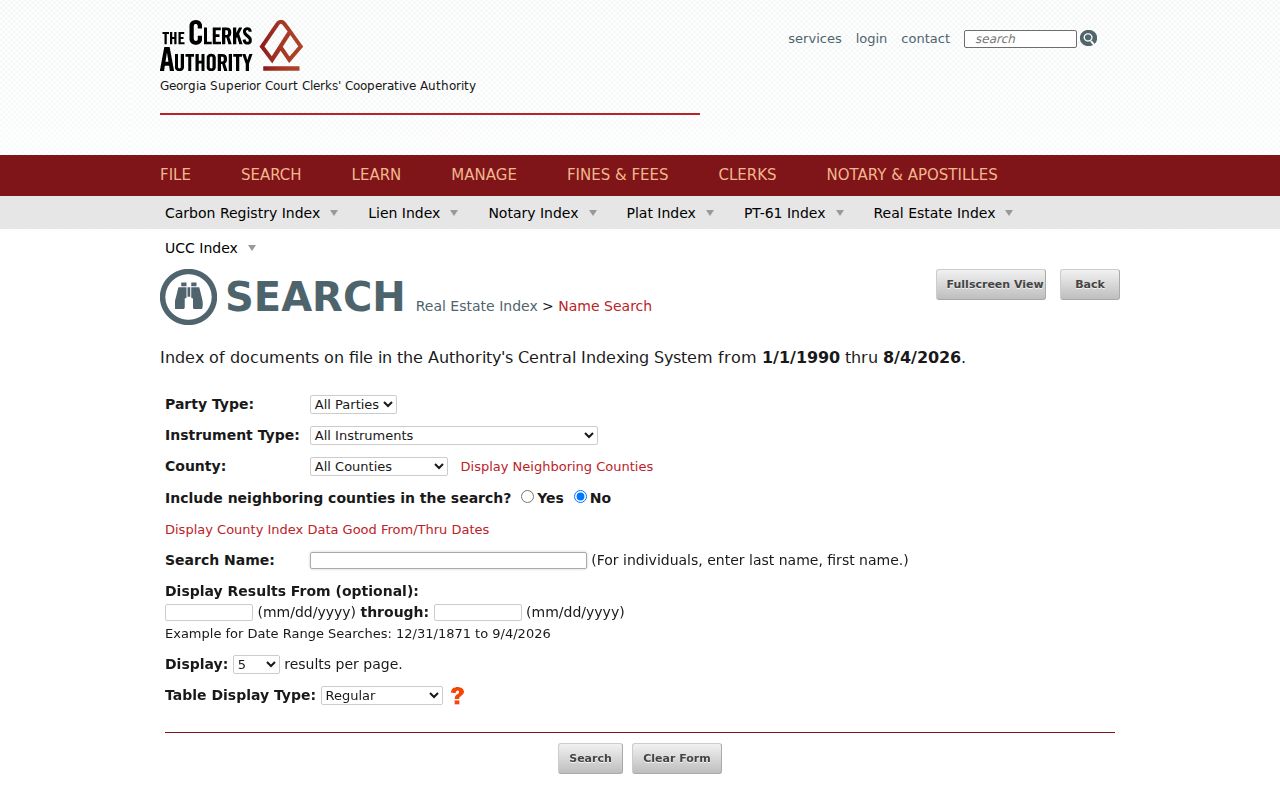
Results hinge on county, date, party role, and spelling choices. Log the exact query with each result, because those choices decide which DeKalb instruments appear.
Map DeKalb Parcels, Not Boundaries
DeKalb GIS links parcels to address and appraisal data. It can also point you to a deed or plat book and page. Verified layers include parcel lines, address points, street centerlines, municipal limits, tax districts, zoning and land-use context, flood and stream features, aerial imagery, and other reference layers. A parcel-buffer function helps too. It shows nearby lots at a glance. Exact controls can change with the viewer.
Parcel: a tax and mapping unit identified by an APN. Plat: a recorded drawing of lots or tracts, and neither term makes the web map a survey.
GIS routes deed and plat copies to the Clerk. The map does not determine title, resolve an encroachment, or certify a property line. Use the polygon to find the record reference. Then compare that reference with the legal description and hire a licensed surveyor when the physical boundary matters.
DeKalb Property Filing Alerts
The Clerk offers a system called FANS. Its full name is the Filing Activity Notification System, and it emails a registered user when a selected name or property appears in a new land-record filing. FANS is a monitoring tool, nothing more. It cannot reject a fraudulent document, certify who owns the parcel, or replace a fresh search of the deed index. A Clerk notice flagged erroneous alerts from an upgrade. Independent verification matters. When an alert lands, open the official Clerk or GSCCCA record instead of following an unfamiliar message link. Compare the instrument number, parties, property description, and APN. Call the Real Estate Division at 404-687-3812 if the filing looks wrong. Keep the alert and a screenshot for a report, but treat the email as paper, not as the land record.
DeKalb City Lines Change Permit Searches
DeKalb County counts 13 municipal areas. One is a partial Atlanta area. City lines ignore ZIP codes and mailing-city labels. County deeds, assessments, taxes, and parcel identifiers remain the core record system for every address. Permit files often live elsewhere. Building, zoning, variance, code, and development records may sit with Brookhaven, Dunwoody, Stonecrest, or another municipality, so confirm the parcel's city limit before choosing an office. Incorporation dates make useful cutoffs. Brookhaven holds city-era planning records and reports that some older, county-processed rezoning files it maintains reach back to the 1950s. Dunwoody warns that a building record may not always exist. Stonecrest routes applications, payments, and inspection requests through CitizenServe. A failed city search can mean the wrong jurisdiction, an older county file, an account gate, or a paper record, not a clean construction history.
Request Missing DeKalb Records
Under the Georgia Open Records Act, O.C.G.A. §§ 50-18-70 through 50-18-77, an agency must open its existing public records. Put yours in on request. Name the custodian. Then identify the address, parcel number, record class, date range, case or instrument number, and the format you prefer. The agency generally has three business days to produce what it holds. Otherwise it must describe the material, estimate time and cost, and cite the exemption behind anything withheld.
Search time has limits too. The first 15 minutes of qualified staff time cost nothing. After that, the agency may bill at the rate of its lowest-paid qualified employee. Ordinary letter or legal copies stay at $0.10 per page unless a certified-copy statute says otherwise. The law does not force staff to build a new report. Ask instead for the permit file, map layer, deed image, correspondence, or case packet that already exists. Skip requests for a history of the property.
Offline channels still work well. The Clerk record room offers mail copy service. ECertification, assessor and tax phone or email lines, GIS mapping help, municipal requests, and the Decatur Library's directories and microfilm all stand ready. A portal outage is a detour, not a dead end, for a DeKalb County property records search.
What DeKalb County Property Records Can and Cannot Tell You
DeKalb County property records answer a lot. They show the owner carried on the annual roll, the parties to a recorded deed, assessed values, sales entries, and tax status. A deed records search also surfaces recorded liens, legal-description clues, plats, and mapped parcel context. When the right city holds the file, permit or zoning history appears too. The limits matter just as much. These records do not prove that every interest was indexed correctly, that title is clear, that a map line is the legal boundary, or that an assessed value matches a current sale price.
Lawful use. Use DeKalb County property records for property research, due diligence, house history, boundary preparation, tax review, and civic transparency. Never use owner information to stalk, harass, threaten, or harm a person.